A Compliance-First EU Permanent Residency Route For Non-EU Families With Clear Contribution And Property Rules
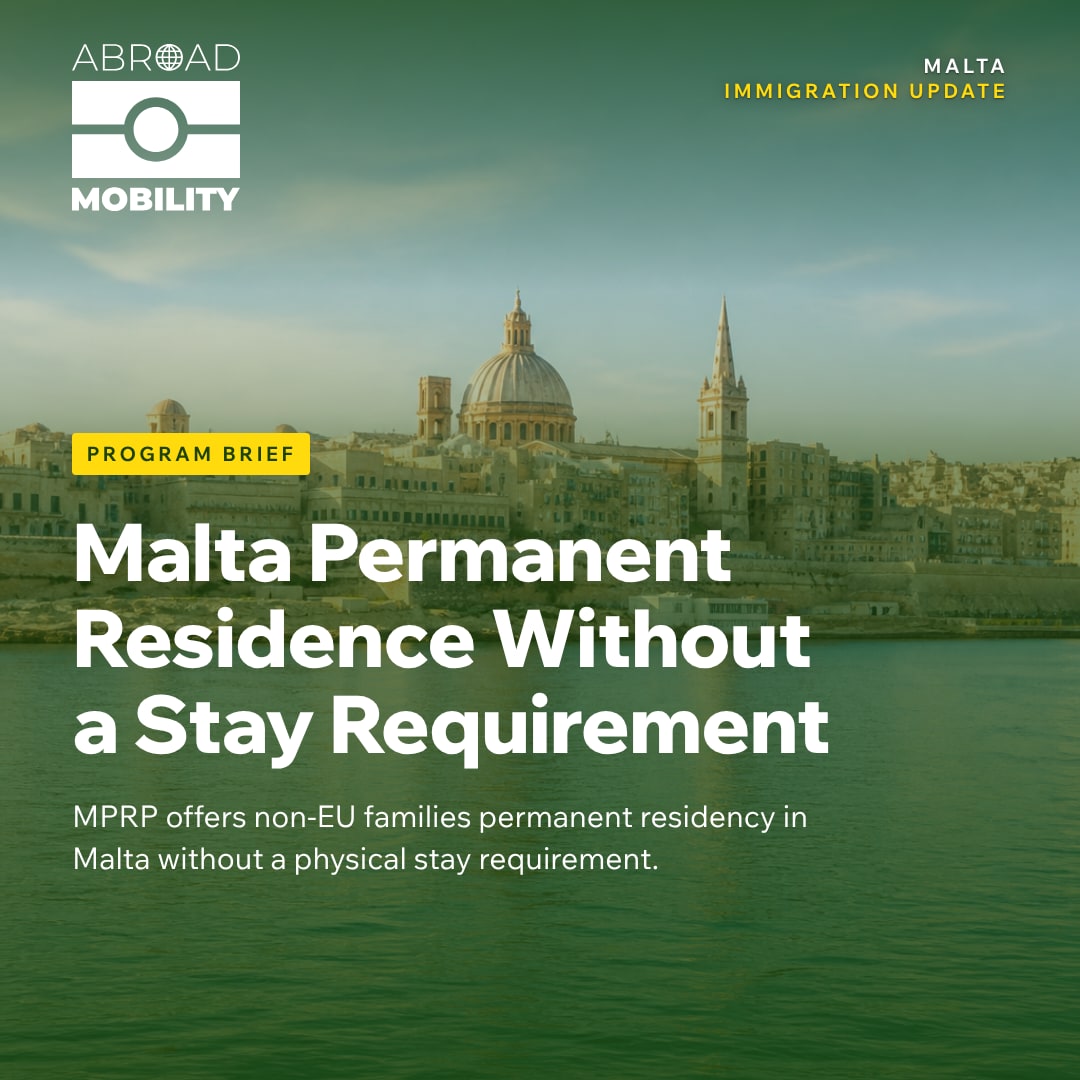
When your clients want a stable, long-term European base without a physical stay requirement, the Malta Permanent Residence Program (MPRP) is a structured residence by investment option leading to permanent residency (PR) in Malta. It is designed for non-EU nationals who can complete a defined government contribution and property commitment, and who are prepared for strict due diligence. For Canadian firms supporting globally mobile families, founders, and private-client households, MPRP can sit neatly within a broader mobility plan where the client values indefinite residence rights in Malta and Schengen travel access, while keeping expectations clear that this pathway is a PR outcome rather than citizenship.
Who The Program Fits
MPRP is generally best aligned with clients who want:
- Permanent residency in Malta, with the right to live indefinitely in Malta.
- Schengen short-stay travel as part of their mobility planning (visa-free travel for up to 90 days in any 180-day period).
- A family-inclusive file, where a spouse or partner, children, and eligible parents may be added under defined fee rules.
- A program without physical stay, language, or education prerequisites, particularly for clients maintaining business and personal ties across multiple jurisdictions.
In practice, many firms position MPRP as a documentation-heavy, compliance-led PR route for clients who can demonstrate sufficient financial resources and complete the program’s contribution, property, and administration fee components. For early-stage screening, Abroad Mobility’s Eligibility Engine can help your team confirm fit before deeper document work begins.
Eligibility And KYC/AML Considerations
The Malta Permanent Residence Program is aimed at non-EU nationals and their families. Eligibility is tied to a client’s ability to meet:
- Financial capacity, including the ability to demonstrate sufficient financial resources.
- Program financial components, including a government contribution, property commitment, and administration fee, plus a charitable donation.
From a risk and compliance standpoint, MPRP is explicit about exclusions. Applicants from the nations of Afghanistan, North Korea, and Iran, and applicants who are sanctioned or pose security risks, are ineligible. For advisory teams, this supports an early, compliance-first intake workflow that includes background screening and a conservative approach to source-of-funds and supporting documentation expectations.
Costs (Program Components And All-In Estimate)
The program’s stated financial structure includes a defined administration fee and government contribution, plus a qualifying property commitment and a small charitable donation.
| Cost Item | Amount |
|---|---|
| Government contribution | EUR €37,000 |
| Non-refundable administration fee (main applicant) | EUR €60,000 |
| Non-refundable administration fee (each dependant, where applicable) | EUR €7,500 |
In most cases, costs for Malta Permanent Residence Program include the non-refundable administration fee, legal support, due diligence, document legalization, property costs, and the qualifying contribution and donation. Total all-in cost will often sit around USD $190,000, with the final figure depending on route selection, number of applicants, and professional services.
Process And Timeline
For client planning and your firm’s case pacing, MPRP decisions are communicated within a reasonable timeframe, with 8 months applying to post-approval steps. Timelines depend on the authority and the case, and your file strategy should assume that responsiveness to document requests and the completeness of the supporting package will influence throughput.
For many Canadian practices, a practical workflow is: eligibility screening, family mapping, document collection and legalization planning, then submission and ongoing request management through decision. The program overview and intake pathway is maintained on Abroad Mobility’s Malta Permanent Residence Program page.
Family And Dependents
MPRP supports family inclusion under clear categories and fee rules. Eligible family members include:
- Spouse, including civil union or common law partner.
- Children under 18, and disabled adult children, at no extra fee.
- Unmarried dependent children under 29, at EUR €7,500 each.
- Dependent parents or grandparents, at EUR €7,500 each.
For intake, it is helpful to map family members against these categories early, since the administration fee includes a dependant charge in some cases and exemptions in others (including for certain dependants such as the spouse and minor children).
Compliance Notes For Case Preparation
- Screen for exclusions upfront, including nationality-based ineligibility (Afghanistan, North Korea, Iran) and any sanctions or security-risk indicators.
- Plan for due diligence and document legalization as part of the overall file build, alongside legal support and property documentation.
- Separate program components clearly for the client, including the administration fee, government contribution, property commitment, and charitable donation, so the funding narrative and supporting documents remain consistent.
- Align expectations on outcomes: MPRP provides permanent residency in Malta and Schengen short-stay travel parameters, and it does not lead to citizenship.
Where a client is still clarifying objectives and constraints, the GAMI Mobility Index is a useful starting point for structured conversations about mobility goals, without treating any single metric as a recommendation.
If you have a client scenario where EU permanent residency, family inclusion, and a no-physical-stay structure are central, Abroad Mobility can support you through intake, eligibility screening, documentation coordination, and application co-management. Share the case outline through our program contact pathway: request MPRP details and onboarding steps.
This information is general and subject to change, and it is not legal advice. If you want, send a brief fact pattern (family composition and high-level objectives) and we will suggest the most relevant next questions for screening.