
Law No. 7582 Defines Conditions for Qualifying Non-Domiciled Status From June 2026
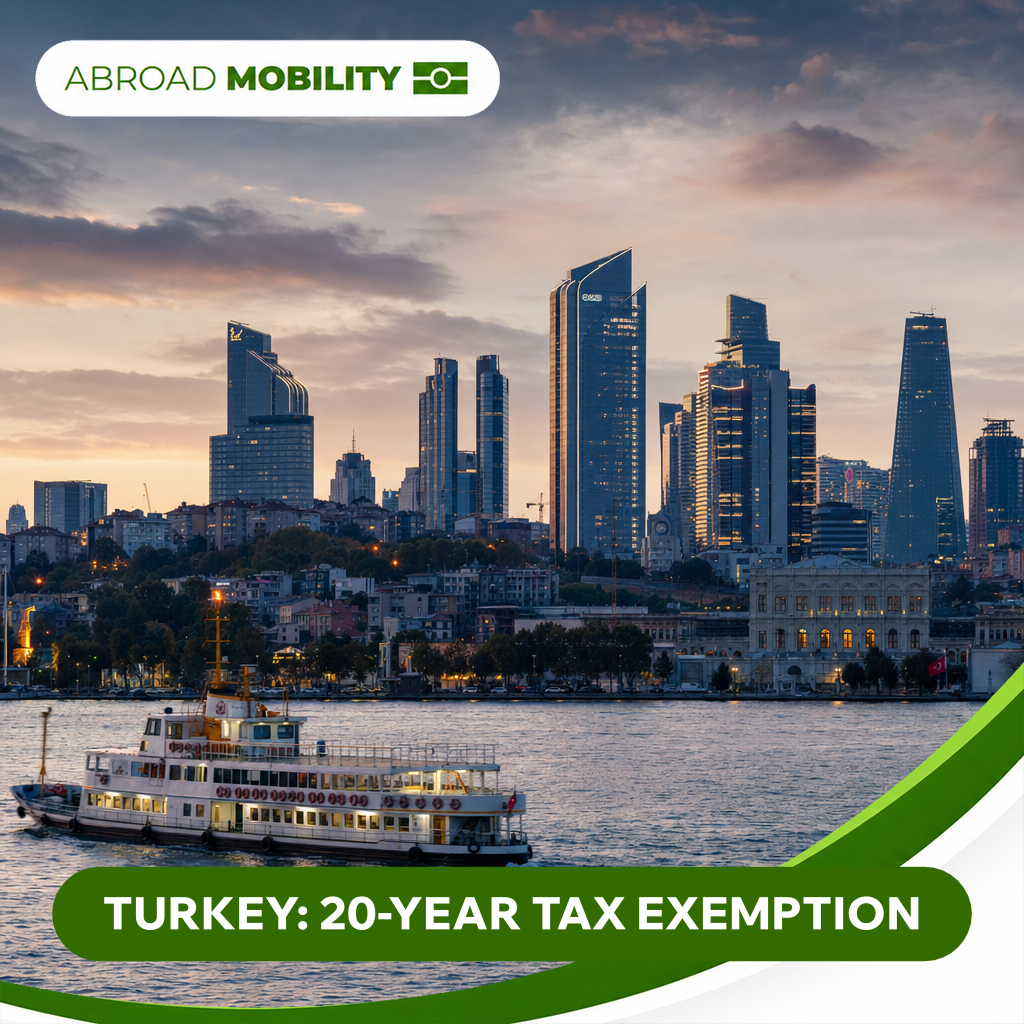

Turkey’s Law No. 7582, published in the Official Gazette on 4 June 2026, adds a long-duration exemption that can result in a zero percent Turkish tax rate on qualifying foreign-source income for new tax residents. The reform positions Istanbul and the broader Turkish market as an emerging base for globally mobile investors seeking compliant tax residency rather than short-term visa convenience. It also raises strategic sequencing questions for advisors managing clients’ relocation, asset onboarding, and citizenship-by-investment filings.
For Canadian immigration and wealth advisors partnering through Abroad Mobility, understanding how to substantiate new-resident status, maintain clean source-of-funds documentation, and time associated investment-migration filings is critical. Law No. 7582 creates opportunity, but only for correctly sequenced, fully taxed-transparent cases.
Who This Fits
The regime may assist globally mobile founders, fund principals, and family offices seeking tax-resident status in a G20 country while keeping foreign investment and business income outside local taxation. For advisors in Canada, it is most relevant to those structuring clients’ second residency or citizenship plans that already include a Turkish element, such as property acquisition, strategic central-time-zone presence, or regional business incorporation.
Clients with clean offshore income verified under Canadian and international anti-money laundering standards may benefit, provided they have not been Turkish tax residents in preceding years and meet six-month physical presence or domicile criteria defined by Turkish tax authorities.
Eligibility and KYC/AML Checklist
Law No. 7582 applies to “new tax residents” meeting defined conditions. Advisors should prepare the following evidentiary set to substantiate status and maintain compliance:
- Proof of non-residence in Turkey during prior fiscal years (residence certificate or foreign tax assessment may support this).
- Formal registration as a Turkish tax resident under post-2026 rules.
- Bank account opening approval with Turkish KYC documents (passport, proof of address, Turkish tax number).
- Documented source of funds for assets relocated to Turkey (audited statements or bank reports consistent with FATF standards).
- If real estate is purchased, notarized title deed and registry extract showing unencumbered funds.
Advisors should confirm that each client’s financial records meet both Canadian and Turkish KYC standards before application submission. Verification through Abroad Mobility’s back-office review can reduce documentation risk at the filing stage.
Investment Routes and Fee Illustration
| Route | Indicative Minimum Investment | Typical Government / Legal Fees |
|---|---|---|
| Turkish Real Estate Purchase (citizenship route) | USD 400,000 unencumbered property value | USD 7,000-10,000 government + legal combined (approx.) |
| Bank Deposit Route (CBI) | USD 500,000 fixed deposit, 3 years | USD 5,000-8,000 government + legal combined (approx.) |
| Entrepreneur/Job Creation | Capital equivalent to 50 employees or USD 500,000 investment | variable |
Figures reflect the official thresholds current as of 2026. Program eligibility and associated taxes remain subject to individual government verification.
Process and Timelines
1. Establish Tax Residency
Residency for tax purposes is determined under the Income Tax Law by domicile in Turkey or by presence exceeding six months. Advisors should begin this step at least several weeks before formal tax-period assessment to ensure the “new resident” condition is satisfied from the outset.
2. Local Bank Onboarding
Turkish banks apply detailed due-diligence rules. Source-of-funds review can take up to several weeks, requiring certified statements and translations. Coordination between Canadian source institutions and Turkish banks is essential to preserve audit trails.
3. Real Estate or Deposit Certification
Investment proof certificates are issued by the relevant Ministry after valuation and registry verifications. The sequence should align so that ownership or deposit confirmation precedes any citizenship-by-investment filing.
4. Citizenship or Long-Term Residency Filing
Once the investment and bank certifications are in place, applications proceed to the Directorate of Population and Citizenship Affairs or equivalent regional office. Case processing typically spans several months, subject to security and source-of-funds clearance.
Program Risks and Change Notes (June 2026)
Law No. 7582 reinforces the economic incentive framework but maintains the fundamental tax concepts unchanged. Turkish-source income continues to be taxable. Only qualifying foreign-source income of new residents is covered. Renewals, exit tax treatment, and ongoing compliance monitoring are expected to follow the General Communiqué already issued on Article 20/D. Advisors should maintain conservative assumptions until the Ministry of Treasury and Finance publishes implementing guidelines.
Co-Managed Support Framework
Canadian RCICs and law firms may handle primary client communication while Abroad Mobility’s back office coordinates Turkish counsel and document verification. This model ensures confidentiality, preserves client ownership, and provides professional-grade compliance records. Partners gain access to the platform’s risk screening and benchmarking tools, including the GAMI Mobility Index, to position Turkey’s new-resident regime within global tax and mobility comparisons.
Compliance Notes
For partner firms:
- Retain certified source-of-funds documentation and translation copies.
- Register client onboarding under your firm’s KYC policy referencing both Canadian and Turkish AML frameworks.
- Confirm the client’s previous tax residence and file a signed declaration of non-resident status for prior years.
- File through government-authorized intermediaries only; do not use sub-agents without CICC-compliant agreements.
This material is informational and does not constitute legal or tax advice. Each case requires confirmation with Turkish tax counsel and independent due diligence review before file submission.
Law No. 7582 signals Turkey’s intent to join the roster of major inbound-residency jurisdictions offering formal exemptions for foreign income. For Canadian advisors, sequencing tax residency, banking and investment steps through a compliant partner platform offers a way to integrate this regime responsibly into global client strategies.
Firms seeking vetted local counsel and co-brandable infrastructure for investor citizenship or residency cases can begin with Abroad Mobility’s Strategic Partnership Program.
To discuss specific cases or start a collaboration, contact Abroad Mobility for a consultation and partner onboarding.
Source: Turkey Official Gazette Publication of Law No. 7582 (June 4, 2026)


